By Abdulkareem Haruna
Stakeholders in Nigeria’s health sector have called for a paradigm shift in the management of non-communicable diseases (NCDs), advocating for the integration of community-based care and patient-led models to improve health outcomes in conflict-affected regions.
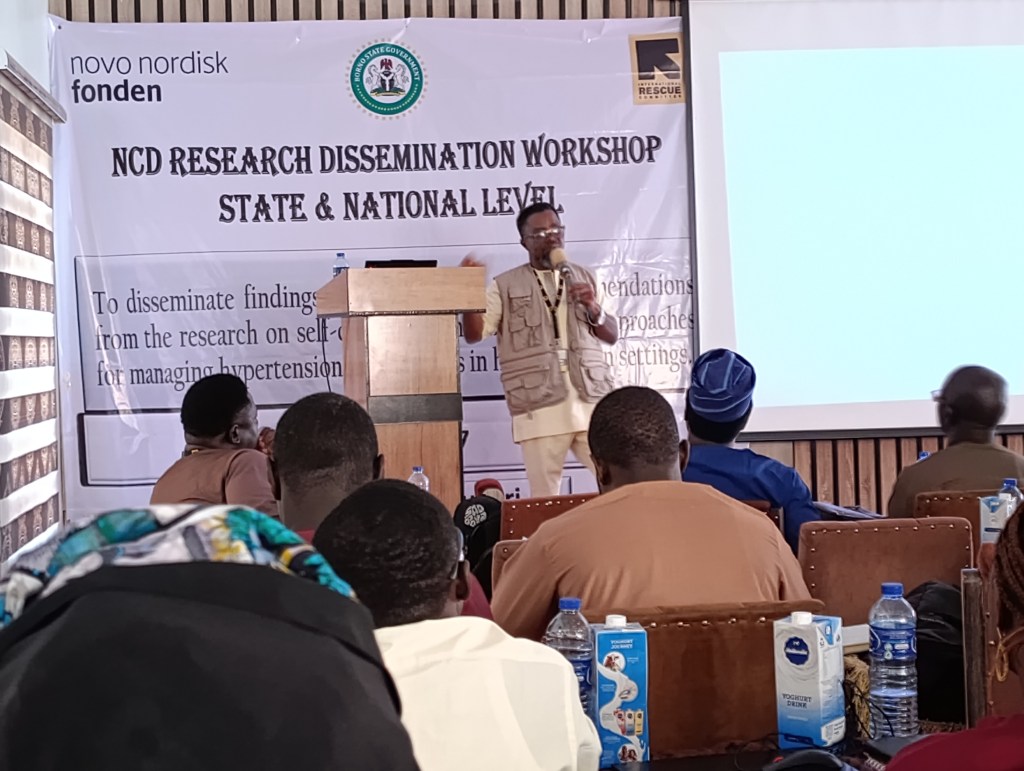
This call was made during a one-day dissemination workshop held in Maiduguri, where the International Rescue Committee (IRC) unveiled findings from a two-year pilot research project on hypertension and diabetes care.
The project, funded by the Novo Nordisk Foundation, was implemented in Maiduguri Metropolitan Council, Jere, and Gwoza local government areas of Borno State.
The well attended workshop was held at Oakland Hotel Maiduguri where participants from the Humanitarian circles, the ministry of health and the media spent hours going through the reports and making their recommendations, observations and constructive critiques.
Bridging the Care Gap
Dr. Okey Oguejii, Senior Program Manager for the IRC in Maiduguri, explained that the study sought to determine the most effective strategy for managing NCDs in a conflict setting, where health infrastructure is often fragile and data is scarce.
“We wanted to answer the question: which of these will improve hypertension and diabetes outcomes in a conflict setting?” Dr. Kachi said.
“We compared two models: a community health worker-led model and a patient-led self-care model. The findings revealed that both are highly effective when combined with essential pillars like consistent drug availability, regular screenings, and home visits.”
He noted that the compassionate care provided through these models addressed not just the physical ailments, but also the mental burden caused by the trauma of conflict and displacement, which often exacerbates conditions like hypertension.
Federal Ministry Calls for Early Intervention
Speaking at the event, Dr. Alayande Shopekan, Director and National Coordinator of the Non-Communicable Diseases Control Programme at the Federal Ministry of Health and Social Welfare, emphasized the urgency of early detection.
“We need to focus on early identification because that is the crux of the issue,” Dr. Shopekan stated.
“By the time patients present at facilities, they often have advanced complications. Managing both the disease and its complications creates a double burden, especially in an environment where care is often out-of-pocket.”
Dr. Shopekan encouraged residents to adopt proactive health-seeking behaviors, such as routine blood pressure and glucose monitoring using home devices, and making informed dietary choices to reduce salt and sugar intake.
He affirmed that the Federal Ministry is currently developing national guidelines to standardize the identification and management of NCDs, including the growing concern of Chronic Kidney Disease linked to diabetes and hypertension.
Sustainability and Future Outlook
Fatima Baba Isa, IRC Health Manager in Borno State and a member of the research team, highlighted the importance of state ownership for long-term impact.
“The Ministry of Health’s role is vital in providing oversight and ensuring that the gains of this research are sustained beyond the life of the donor funding,” Ms. Isa explained.
“This was a pilot project, and our goal is to see these models expanded to provide intentional, continual management for people living with these conditions across the state.”
Key Policy Recommendations
The workshop concluded with a roadmap for scaling these interventions, highlighting the following imperatives:
Policy Integration:Nigeria should refine existing policy instruments to explicitly embed NCD self-care and task-sharing with community health workers.
Resource Allocation: Programs must prioritize the uninterrupted supply of essential medicines and the provision of monitoring devices (BP machines and glucometers) at the community level.
Contextualized Care: Future initiatives should focus on food affordability and localized guidance on healthy diets, ensuring that patients can effectively act on medical advice.
Domestic Financing: As donor funding eventually diminishes, stakeholders must advocate for the domestic financing of these care models to ensure a sustainable, trained health workforce.
 The Humanitarian Times
Leave a comment