
Things are getting very interesting in Borno state especially in the high wired political space of Borno South Senatorial District, where the incumbent Senator, Mohammed Ali Ndume appears to be borrowing a page from the old populist playbook.
Facing a recent sophisticated challenge from the Deputy Speaker of the Borno State House of Assembly, Abdullahi Askira, Ndume’s camp has intensified efforts to sell a narrative of “popular demand” ahead of the 2027 general elections.
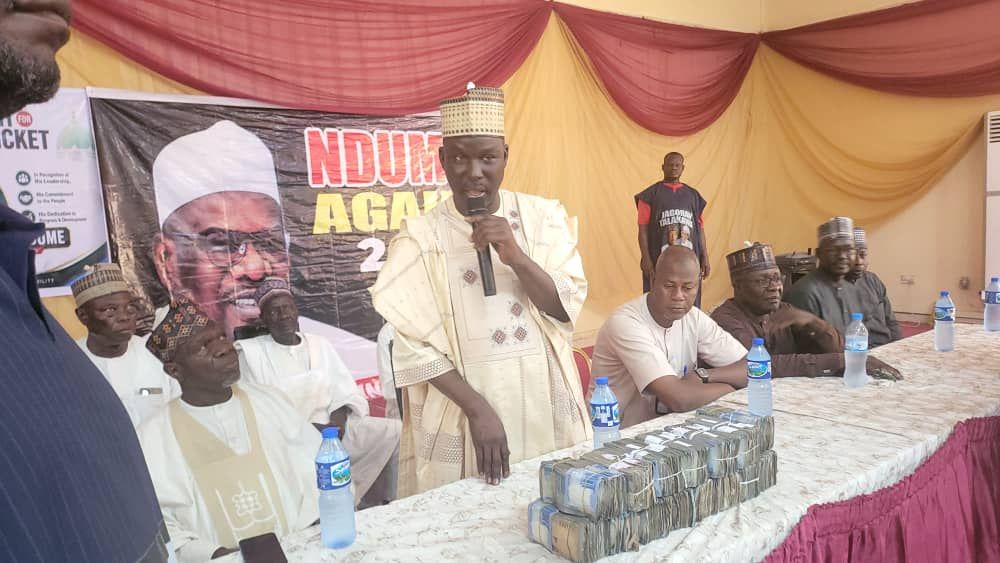
On Saturday, a seemingly carefully choreographed gathering at Forshams Hall in Maiduguri saw youth groups purportedly from the nine local government areas of the district announce a physical cash contribution of N38.5 million to purchase nomination forms for Ndume’s fifth-term bid. Interestingly, while the other nine local government areas in the zone purportedly contributed N2 million each, Askira-Uba – the home base of his primary challenger – reportedly donated N5 million. Rather than demonstrating local loyalty, this disproportionate figure suggests a calculated, orchestrated effort to project support in the very stronghold where his influence is most under threat.
While Ndume’s supporters like Alhaji Babandi Shehu frame this as a grassroots referendum on the Senator’s “fearlessness,” political analysts view the sudden windfall as a desperate defensive maneuver against the rising profile of Abdullahi Askira and a growing outcry for the restoration of a long-neglected rotational agreement.
The “Pseudo-Group” Strategy
The optics of the N38.5 million cash donation – featuring contributions from Maiduguri timber sellers and transport unions – are classic Nigerian political “astroturfing.” By presenting himself as a candidate drafted by the masses, Ndume seeks to mask a waning influence within the core power structures of the All Progressives Congress (APC) in Borno State.
Despite his legislative aide’s laundry list of achievements – including 76 bills and several educational institutions – gthe reality on the ground suggests a fatigue with Ndume’s two-decade-long grip on the National Assembly (having served in the House of Representatives before his 2011 entry into the Senate).
“This isn’t about bills or houses in Gwoza anymore,” says a high-ranking APC stakeholder who requested anonymity. “This is about equity. Ndume has become a permanent fixture, and the people of the other axis are saying ‘enough is enough.’”
The Askira Factor: A Return to Rotational Equity
The primary source of Ndume’s current anxiety is the silent but potent momentum gathering behind Abdullahi Askira. Unlike the noisy, cash-heavy rallies of the Ndume camp, the call for Askira is framed as a moral obligation to restore the “Southern Borno Rotational Agreement.”
For years, an unwritten pact ensured that the senatorial seat rotated between the diverse ethnic and geographical blocs of the district. Ndume’s insistence on a fifth term is seen by many as a continuation of a breach of this communal trust.
Constituents calling for Askira argue that the Deputy Speaker represents a bridge between the old guard and the new generation—a leader whose influence is rooted in legislative stability at the state level rather than the confrontational, often erratic “truth to power” brand that Ndume has cultivated in Abuja.
Analysis: A Tale of Two Campaigns
The contrast between the two camps is stark:
The Ndume Camp: Relies on financial displays and the projection of “fearlessness.” The mobilization of youth groups to “donate” millions is a preemptive strike to signal to the party leadership that Ndume remains a “man of the people.”
The Askira Movement is grounded in the demand for structural fairness. The push for the Deputy Speaker is less about purchasing forms and more about reclaiming a seat for a sub-region that feels systematically marginalized by Ndume’s longevity.
The Insecurity and the Ego
While Ndume’s aide, Maiva, highlights 280 houses built for IDPs in Gwoza and Damboa, critics argue these are “drops in the ocean” compared to the sustained political representation the district deserves. The “Nationalist” label applied to Ndume by his coordinators is also being scrutinized; being a “critic of the executive” in Abuja has often yielded little tangible development for the average voter in Bayo or Shani compared to the influence he has wielded for 21 years.
In Biu – the political heartbeat of the Borno South Senatorial District – constituents are less concerned with Senator Ndume’s reputation as a “national hero” and more focused on local accountability, specifically demanding to know why the federal government abandoned the critical Biu Dam project.
As the 2027 race draws closer, the N38.5 million “donation” may prove to be a hollow victory if the grassroots demand for Abdullahi Askira continues to crystallize around the principle of rotation. For Ndume, the challenge is no longer just “checking the excesses of the executive,” but checking the growing impatience of a constituency that is tired of the status quo.
In Borno South, the era of the “perpetual candidate” is facing its stiffest challenge yet, and no amount of “on-the-spot” cash collections” can easily silence the call for equity.
 The Humanitarian Times
Leave a comment