By Abdulkareem Haruna
In Borno politics, timing is everything. It isn’t just a matter of luck; it is sometimes a weapon deployed to shape the future. For months now, the political atmosphere in Maiduguri, the state capital, and even outside, has been thick with anticipation.
Analysts and power brokers viewed the countdown to the end of March 2026 as the “Day of Revelation” – the moment when the veil would be lifted on who Governor Babagana Umara Zulum and his political godfather-cum predecessor, Vice President Kashim Shettima, had anointed to succeed the incumbency in 2027. It was like the Ides of March.According to the Independent National Electoral Commission (INEC) guidelines, public officers nursing ambitions for the upcoming party primaries were mandated to resign their appointments by the end of the month. Naturally, the public in Borno state expected a trickle of strategic resignations; instead, they got a mass dissolution.
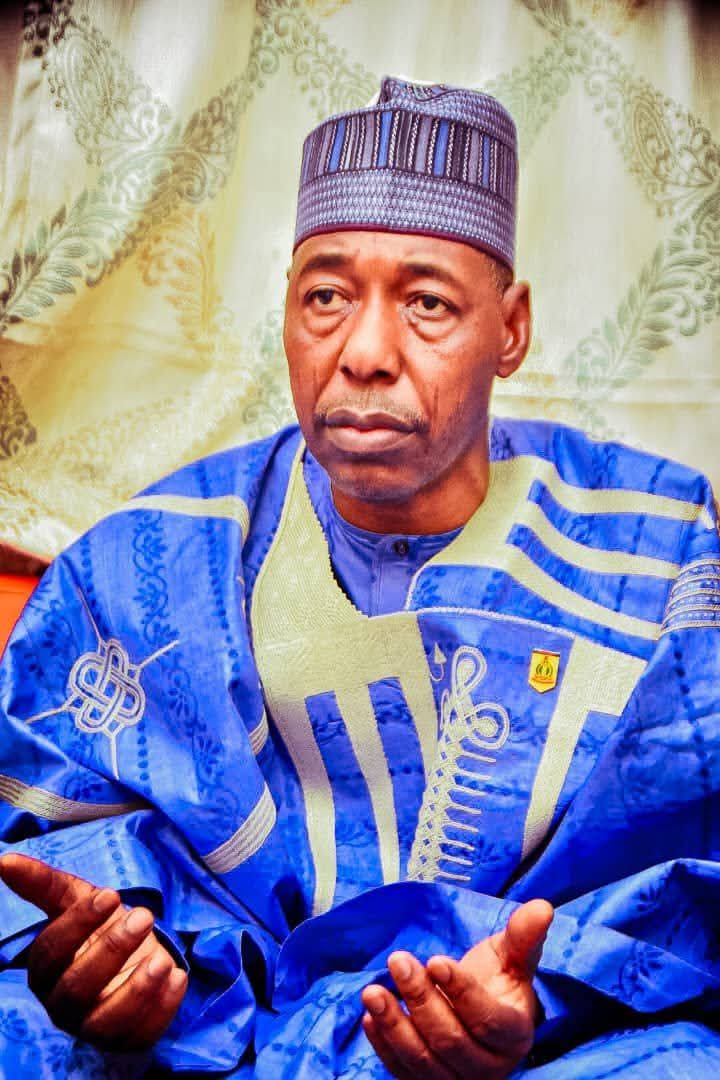
In a move that has sent shockwaves through the political landscape of the state, Governor Zulum preemptively announced the dissolution of his entire State Executive Council.The press release, signed by the Secretary to the State Government, Bukar Tijani, was terse but loaded. It stated that the dissolution was to “provide an enabling environment for any member of the executive council who may wish to contest elective positions.” While framed as an act of democratic magnanimity, the reality is far more complex. By ‘sacking’ everyone, Zulum has effectively cast a thick shroud of darkness over the sands of public perception, leaving the identity of the “chosen one” more elusive than ever.“Initially, we waited to see who will resign amongst the list of those being named in the succession game, but here we are left more confused weeks to the day of the governorship primaries,” said a notable APC former state executive who doesn’t want to be named in this article.The Strategy of ConcealmentBefore this carpet dissolution, the formula for identifying who the preferred candidate would be was simple: watch who resigns. Borno’s political culture is strictly top-down; venturing out for an elective seat without “approval from above” is unheard of. This is why a Commissioner’s resignation ahead of party primaries is seen as a strategic move backed by the “nod” of Zulum and probably VP Shettima.While the cabinet dissolution seems straightforward, many believe there are veiled ambitions at play, with certain candidates waiting in the wings for the Governor’s ultimate signal.Now, every former Commissioner is on the same footing. None can be singled out as having taken the initiative to quit, and none can be stigmatised for staying behind. This strategy serves a dual purpose: it prevents the “lame duck” syndrome where a governor’s authority wanes once a successor is identified, and it protects the preferred candidate from early political “attacks” by rivals.However, this assumed tactical brilliance comes with a democratic cost. The delay in identifying the frontrunners creates a vacuum of uncertainty. When a successor is hidden until the eleventh hour, the electorate and party faithful are denied the opportunity to scrutinise the candidate’s vision, temperament, and preparedness. It risks a ‘forced consensus’ where the choice of two men is imposed on millions, potentially stifling internal party democracy. But in Nigerian politics, all strategies are considered noble as long as it guarantees the success of vested interests.The Heavyweights in the ShadowsDespite the Governor’s attempts to mask the field, the political grapevine in Borno is buzzing with names. Several members of the now-dissolved cabinet have long been suspected of harbouring gubernatorial ambitions. Among those the public will be watching closely in the coming weeks as they navigate their post-cabinet lives are:Barrister Kaka Shehu Lawan: Now a Senator, Kaka Shehu is still seen as a core member of the Zulum-Shettima circle. His every move is now interpreted as part of a 2027 strategy. The prevailing theory suggests that if Zulum seeks the Borno Central Senate seat, Kaka Shehu will be the designated successor for the governorship.Engr. Mustapha Gubio: As the former Commissioner for Reconstruction, Rehabilitation, and Resettlement (RRR), he sat at the heart of Zulum’s signature developmental projects, giving him a profile that resonates with the ‘continuity’ agenda.Prof. Mohammed Arab Alhaji: The former Commissioner for Health, known for his clinical efficiency, is whispered to be a dark horse in the race. His being a Kanuri-Shuwa extraction may advantage him to get the nod of the big men.Hon. Sugun Mai Mele: The former Commissioner for Local Government and Emirate Affairs, a veteran and most cognate politician with a formidable grassroots network essential for a state-wide mobilisation. Mele has served in both stretches of Kashim Shettima and now Zulum’s cabinets as commissioner. An analyst once said,, “Undermining Sugun Mai Mele in this 2027 contest could be tantamount to political harakiri.” He is also likely a dark horse.Engineer Abba Wakilbe, a former energetic commissioner of education who came into the limelight in the second half of Zulum’s administration. He is the toast of many on social media with several posts urging the governor to anoint him as the next helmsman. Many have argued that with Wakilbe as governor, Zulum might never be missed because he possesses the energy and acumen of his boss. It is not certain, however, if the core establishment would accept him and his extremely frank nature.Senator Abubakar Kyari: A seasoned politician, Senator Kyari rose through the executive and legislative branches to become Deputy National Chairman and, later, a Federal Minister. As of the evening of May 31, he has yet to resign as Minister of Agriculture and Food Security. This suggests he is likely not seeking the governorship of Borno State.The Setbacks of the ‘Silent’ ApproachWhile Zulum’s strategy ensures stability within the government, it presents significant setbacks for the state’s political evolution. Firstly, the lack of early transparency breeds anxiety and fuels the rumour mill, which can lead to fractionalization within the ruling All Progressives Congress (APC).Secondly, Borno is a state recovering from over a decade of insurgency. The transition from Zulum – a man whose work ethic has become legendary—requires more than just a loyalist; it requires a visionary. By keeping the aspirants in a ‘state of nature’ where no one is officially running, the opportunity for a robust public debate on the post-Zulum era is lost. The people are kept in the dark, waiting for white smoke to emerge from the Government House, rather than engaging in a robust process of selection.Conclusion: The Long GameGovernor Zulum’s decision to dissolve the cabinet on the very day the public expected clarity is a masterclass in political manoeuvring. It suggests that the Governor and the Vice President are playing a long, sophisticated game, ensuring that the transition does not disrupt the “Borno Model” of development.However, as the Friday, April 3rd deadline for handing over to Permanent Secretaries approaches, the real battle begins. Deprived of their official titles, the supposed aspirants will now have to rely on their personal political capital. The “enabling environment” Zulum spoke of is now a reality, but it is an environment shrouded in fog.In the coming weeks, the silence from the Government House will be deafening. But in politics, silence is often the loudest indicator of an impending storm. The successor is out there, most likely hidden among the ‘displaced’ Commissioners, waiting for the moment the “godfathers” decide the sun is high enough to cast a shadow. Until then, Borno will continue to wait, Borno will continue to watch, and Borno will continue to wonder.
 The Humanitarian Times
Leave a comment